For many algo traders, capital is the bottleneck, not the strategy. An EA that runs well on a €5,000 account of your own barely earns enough there to justify the time. That is why several models for trading with outside capital now exist, and they work in fundamentally different ways. This guide puts five of them side by side: how they run, what they cost, which rules apply, when and on what you are paid, who carries the loss and which EAs fit.
Figures for individual providers come from their websites, with the date (3 Nov 2026) and source at the end. Where we describe a model only in general, we give no figure. Disclosure: we have partner links to FTMO and Darwinex Zero; they are marked as ads, and we receive a commission if you sign up through them.
Funding models at a glance
Five ways to trade with someone else’s capital or your own. They differ mainly in who carries the loss and what your share is calculated on.
As of 3 Nov 2026, figures from the providers
The five models at a glance
| Model | Cost | Rules | Payout | Loss risk | Suits |
|---|---|---|---|---|---|
| Prop challenge (1- or 2-step) | One-time fee per attempt, often refunded with the first payout on 2-step | Profit target, daily loss, overall loss (static or trailing), sometimes minimum trading days | Share of the simulated profit, often 80 to 90%, every 14 days or monthly | The fee | Steady EAs with a fixed stop loss and small intraday drawdown |
| Instant funding | Higher one-time fee, usually not refunded | No target, but tight limits, often trailing, sometimes consistency rules | Share of the simulated profit, often available earlier | The fee | Proven strategies with a very flat equity curve |
| Darwinex Zero / DarwinIA | Monthly subscription, optional Boosters | No loss limits, a risk engine normalises risk, correlation rules | 15% of profits on notional allocations, quarterly (monthly optional) | The subscription | Patient traders with their own, uncorrelated strategy |
| Copy trading / signal providers | Own account, platform fees | Platform rules, public track record | Subscription or performance fees from followers | Own capital | Traders with a long, cleanly documented live track record |
| Own capital | Spreads, commissions, swaps | Only the broker’s (margin, leverage) | 100% of the profit | Own capital | Anyone who can carry losses up to the deposit |
The key question for every model is not the profit share but what it is calculated on and what happens when things go badly. 90% on a simulated USD 100,000 account that ends at a 10% loss is something entirely different from 15% on a notional €30,000 allocation that never ends an account, or 100% of your own money.
Understanding drawdown rules: static, trailing, daily
Almost every funded model works with loss limits. Three terms come up again and again:
- Static overall loss: the limit sits at a fixed level below the starting balance (USD 90,000 for USD 100,000 and 10%) and never moves.
- Trailing overall loss: the limit follows the highest account level reached, depending on the firm based on real-time equity or the daily close. Some firms stop the trailing once the limit reaches the starting balance.
- Daily loss: the loss within one trading day, measured from the balance or equity at the start of the day, open positions included. It starts afresh every day.
Diagram, not real prices
Daily loss limit (not drawn): measures the loss within one trading day from that day’s starting balance or equity, open positions included, and starts afresh every day.
For EAs this means a basket of several open positions counts at its worst interim level, not at its later result. Grid, martingale and averaging strategies therefore clash structurally with trailing and daily limits. More in Grid and martingale EAs: the risks and on position size under daily limits in Position sizing and risk per trade.
1. Prop firm challenge (1-step or 2-step)
- 1Pay a fee
- 2Phase 1: profit target
- 3Phase 2: smaller target
- 4Funded account (simulated)
- 5Profit share
- Who carries the loss
- You can lose the fee at most. The account is simulated, a rule breach ends it.
- How you get paid
- Share of the simulated profit, often 80 to 90%, on a 14-day or monthly rhythm.
How it works. You buy an evaluation for a given account size. In the 2-step version you hit a profit target in phase 1 and a smaller one in phase 2, each without breaching the loss limits. The 1-step version has a single phase, usually with tighter limits or extra rules. Afterwards you trade a funded account that is almost always simulated and receive a share of the profit. The basics are in What is a prop firm?.
Example FTMO (as of 3 Nov 2026):
| 2-Step | 1-Step | |
|---|---|---|
| Profit target | 10% + 5% | 10% |
| Max daily loss | 5% | 3% |
| Max overall loss | 10% | 10% |
| Extra rule | at least 4 trading days | best-day rule 50% |
| Fee (USD 10,000 to 200,000 account) | €89 to €1,080 | €79 to €999 |
| Fee refunded | yes, with the first reward | no |
| Profit share | up to 90% | 90% |
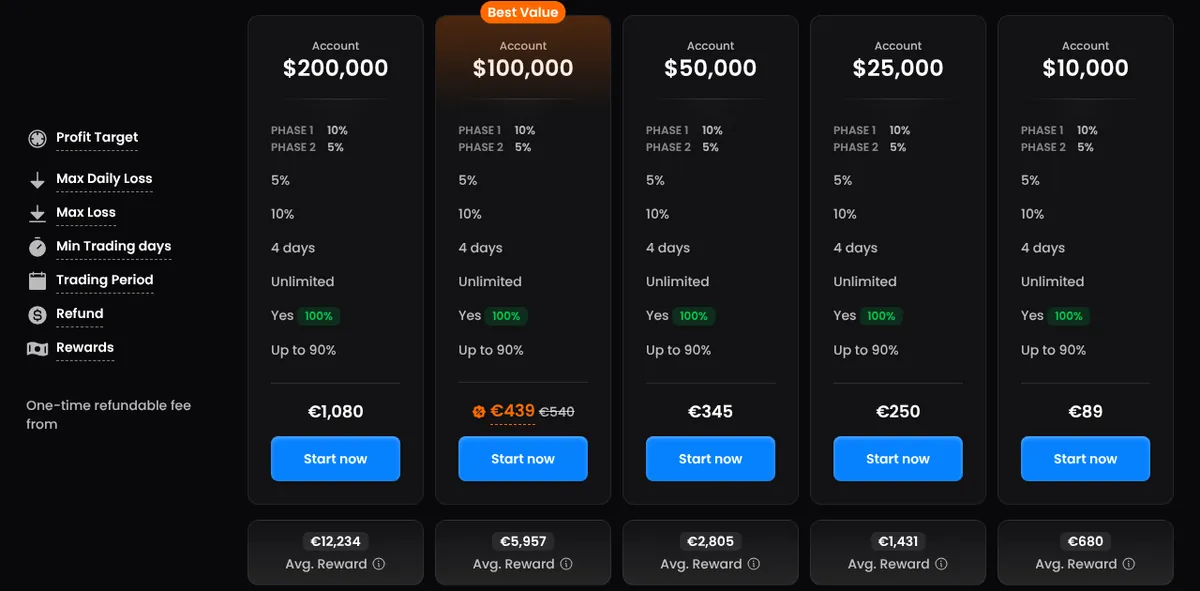
Costs. The list price is the fee for one attempt. The real cost depends on how many attempts you need, because a rule breach ends the account and the fee is gone. Budget for several attempts, not one.
Payout. At FTMO you request a reward no earlier than the 14th day after the first trade on the account; all positions must be closed. FTMO says it typically reviews within 1 to 2 business days and pays within 1 to 2 business days after the invoice is approved, by bank transfer, card, Skrill or crypto. Other firms pay on other rhythms, see our reviews of FundedNext, The5ers and E8 Markets.
Suits traders with a proven strategy that keeps maximum drawdown well below the overall limit and who are willing to trade within someone else's rulebook.
Risks. Losing the fee on failure; rules that can change; banned practices (tick scalping, latency arbitrage, copying between accounts); news and weekend rules depending on the account type.
Which EAs fit. Trend and breakout EAs with a fixed stop loss, few simultaneous positions and a working news filter. Position size must be set by the daily limit, not by the EA's default. The process with an EA is in Passing a prop firm challenge with an EA; EA reviews with live data are in our EA reviews, a package built around prop rules for example under Prop Firm Robots App. How firms treat EAs is compared in Prop firms for algo traders.
Visit FTMO AdPartner link: if you sign up through it, we receive a commission. It does not change what we write here.
2. Instant funding: no evaluation, tighter limits
- 1Pay a higher fee
- 2Account live at once
- 3Keep tighter limits
- 4Profit share
- Who carries the loss
- You can lose the fee at most, usually non-refundable. Limits are tighter, often trailing.
- How you get paid
- Share of the simulated profit, sometimes lower than after a challenge, often available earlier.
How it works. You skip the challenge and buy a funded account directly. The price: a higher one-time fee that is usually not refunded, and rules that are tighter or built differently, often with a trailing limit or a consistency rule. Some firms start with a lower profit share.
Two examples (as of 3 Nov 2026):
| FTMO Instant Account | FundedNext Stellar Instant | |
|---|---|---|
| Account sizes | USD 5,000 to 100,000 | USD 2,000 to 20,000 |
| One-time fee | €169 to €2,999, not refunded | USD 59.99 to 599.99, not refunded |
| Daily loss | 3% | none |
| Overall loss | 10% | 6%, trailing |
| Other rules | consistency 30%, leverage up to 1:100 | news profits count at 40%, EAs only via add-on |
| Profit share | 90% | 70%, up to 80% from tier 3 |
| Payout | request from day 14 after the first trade | on demand from 5% profit or on a 14-day cycle |
A detail from the FTMO FAQ that is easy to miss: on the Instant Account a reward withdrawal does not reset the maximum loss limit. Taking profits out moves you closer to the limit. Whether FTMO Instant's 10% limit is static or trailing is not stated on the product page; check the trading objectives before you buy.
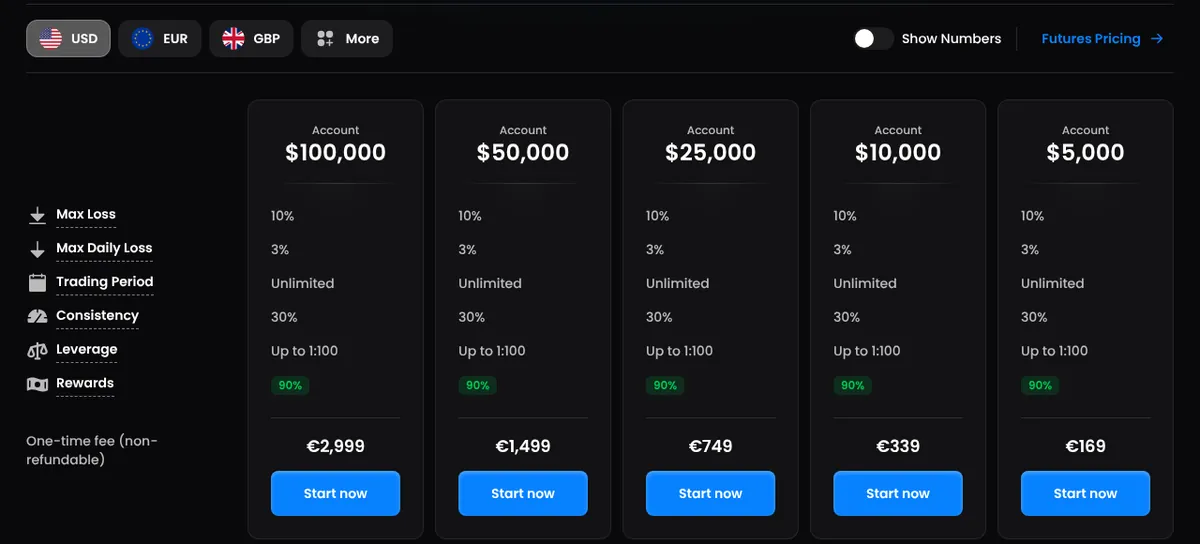
Costs. Weigh the fee against the account size. Per USD 10,000 of account size, an FTMO instant account costs several times a 2-step challenge of the same size; what you buy is time and not having to hit a profit target.
Suits traders with a proven, very even strategy who do not want to spend time on two evaluation phases and can write off the fee as a cost.
Risks. A higher fee lost on an early breach; trailing limits that tighten after a winning run; consistency rules that penalise a single strong day.
Which EAs fit. Strategies with a very flat equity curve, small risk per trade and evenly spread winning days. EAs that make most of their profit on a few days clash with consistency rules; grid and martingale with trailing limits.
3. Darwinex Zero and DarwinIA: track record instead of evaluation
- 1Monthly subscription
- 2Trade a virtual account
- 3DARWIN (risk normalised)
- 4Notional allocation
- 515% of profit
- Who carries the loss
- You lose the subscription. No account loss on drawdowns, but no allocation without a good rating.
- How you get paid
- Performance fee on the allocation, quarterly with a high-water mark, monthly as an option.
How it works. You pay a subscription (from €45 a month, EU/UK) and trade a virtual account. After a calibration a DARWIN is created, an index of your trades whose risk the risk engine normalises to 3.25 to 6.5% monthly VaR. Every month, with a rating of at least 75, the DARWIN receives a notional allocation (DarwinIA SILVER, €30,000 to €375,000, 3 months). On the allocation's profit you receive a 15% performance fee, calculated on a high-water-mark basis, quarterly by default, monthly as an option. From DarwinIA GOLD (more than eight months of history and return/drawdown criteria) real investor money on Darwinex is added.
Rules. No profit target, no daily or overall limit, no account termination. Losses still cost: they lower the rating and with it the allocations. On top come correlation rules and the ban on signals from a common source such as a mass-market EA.
Payout. Credited fees at any time from €100 by bank transfer, after ID and bank verification; typically processed within 24 hours per the help centre.
Suits patient traders with their own strategy who want to build a public track record over a year or more.
Risks. The subscription is certain, the fee is not. 15% on a notional allocation means small amounts; without an allocation you only pay.
Which EAs fit. Own or heavily customised strategies with steady monthly returns and limited drawdown; the rating weights the six-month return at 67%. High-leverage baskets held for long hit the risk engine's D-Leverage limits.
Everything in detail, with screenshots, the payout cycle and a worked example: Darwinex Zero explained.
4. Copy trading and signal providers
- 1Own live account
- 2Publish a signal
- 3Followers copy
- 4Subscription or performance fee
- Who carries the loss
- Your own capital on the signal account. Followers carry their own losses.
- How you get paid
- Fees from followers under the platform’s rules, minus its commission.
How it works. You trade your own live account and publish it as a signal on a platform. Followers copy your trades onto their own accounts and pay a subscription or performance fee for it. The capital you "trade" therefore sits with the followers; you do not manage it, they mirror you.
Costs and rules. Depending on the platform: the costs of your own account, a platform commission on your income, minimum requirements for account size or history. The actual rates vary widely; we deliberately give none here.
Payout. Under the platform's rules, usually monthly. No followers, no income.
Suits traders with a long, cleanly documented live track record who can live with every drawdown being public.
Risks. Your own capital carries the losses; a bad month costs followers and therefore income. Liability and regulatory questions depend on platform and residence.
Which EAs fit. Strategies whose live result is traceable over many months. How to read a track record is covered in Equity curve explained and Forex robot reviews: real results.
5. Your own capital
- 1Deposit with a broker
- 2Trade your own money
- 3100% of profit and loss
- Who carries the loss
- All yours, up to your deposit (negative balance protection for EU retail clients).
- How you get paid
- The whole profit is yours, withdrawals on the broker’s terms.
How it works. You deposit with a broker and trade. No rulebook beyond margin and leverage, no profit share for third parties, but also nobody else carrying losses.
Costs. Spreads, commissions and swaps instead of fees. They apply to every trade and add up for active EAs; compare them in our broker comparison.
Payout. The whole profit is yours, withdrawals on the broker's terms.
Suits anyone who can carry losses up to the deposit, and as a testing ground before you expose a strategy to a rulebook.
Risks. Total loss of the deposit is possible. EU retail clients have negative balance protection.
Which EAs fit. In principle all, grid and martingale included, as long as you understand their risk and only use money you can afford to lose. Getting started is covered in Getting started with algo trading.
Which model fits which EA?
| Your EA | Challenge | Instant | Darwinex Zero | Copy | Own account |
|---|---|---|---|---|---|
| Trend/breakout with fixed stop loss | fits | fits if very even | fits if independent | fits with history | fits |
| Scalper with many short trades | check server-load and news rules | check consistency rule | fits, risk engine scales | slippage for followers | fits |
| Grid, martingale, averaging | hard (daily and overall limit) | very hard (often trailing) | leverage and holding-time limits | drawdowns public | only with money you can lose |
| Purchased mass-market EA | allowed depending on firm | allowed depending on firm | correlation risk, clause 5.3 | little differentiation | fits |
A rule of thumb: test every EA first on a small own account or demo and measure the worst intraday drawdown, not just the closing drawdown. Only then can you say which rulebook it survives. How to test is in Backtesting and forward testing.
Common misconceptions
- "90% is more than 15%." Only on the same base. What matters is what the share is calculated on and how often a rule breach sends you back to zero.
- "No evaluation means easier." Instant funding moves the hurdle from a profit target to tighter limits and a higher fee.
- "No drawdown limit means no consequence." At Darwinex Zero a drawdown costs rating and allocations for months.
- "The money is real." The payouts are real, the accounts and allocations almost always simulated or notional.
Sources
All pages accessed on 3 Nov 2026; screenshots from the same day.
- FTMO: 2-Step Challenge (targets, limits, fees €89 to €1,080), 1-Step Challenge (10% target, 3% daily, best-day rule, fees €79 to €999), Instant Account (USD 5,000 to 100,000, €169 to €2,999, 3%/10%, consistency 30%, 90%), Trading Objectives, reward withdrawal (from day 14, 1 to 2 business days, no max-loss reset on Instant), fee refund (2-Step only)
- FundedNext: Stellar Instant (no daily limit, 6% trailing, 70 to 80%, payout on demand from 5% or every 14 days, fees USD 59.99 to 599.99, EAs via add-on)
- Darwinex Zero: pricing, DarwinIA SILVER, DarwinIA GOLD, performance fees, risk engine, withdrawals, Terms of Business
- Copy trading and own capital: described in general, without provider-specific figures.