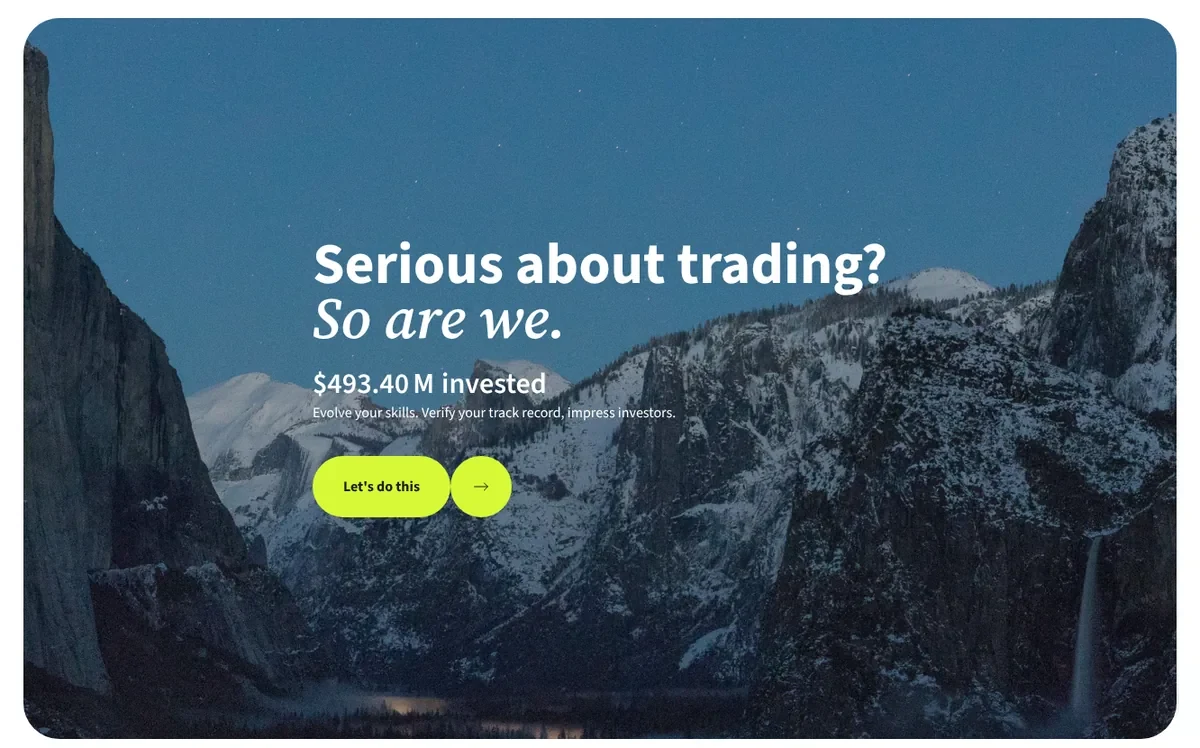
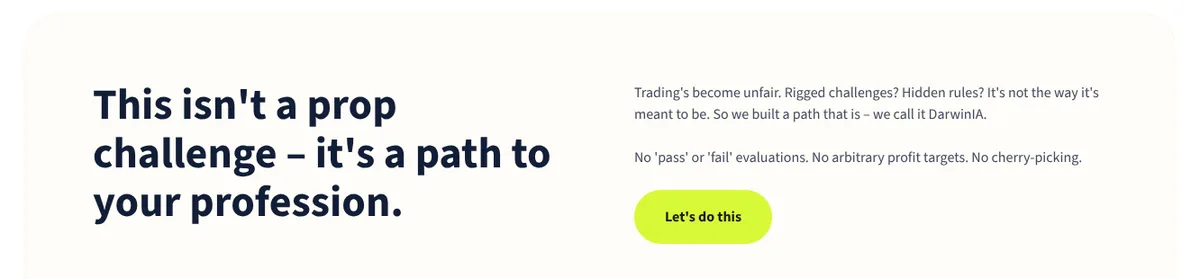
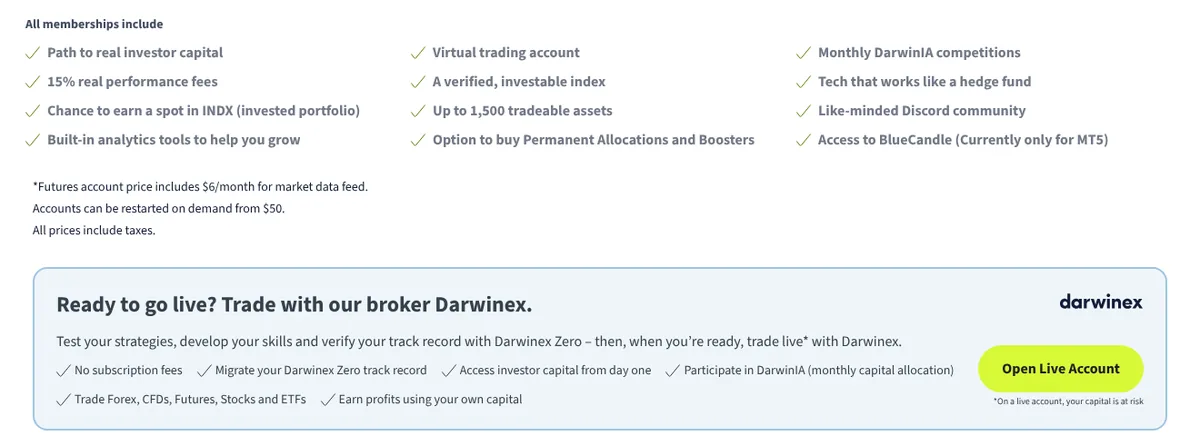
Darwinex Zero's tagline is "This isn't a prop challenge". That is true, and it is exactly why the offer is often misunderstood. There is no profit target, no evaluation and no account that is closed at a 5% daily loss. But there is also no "funded account" on whose profit you keep 80 or 90%. You are paid 15% of the profit on notional allocations that your track record has to earn. This guide explains the logic step by step, with screenshots of the public pages of darwinexzero.com and darwinex.com (as of 3 Nov 2026) and our own graphics.
Disclosure: we have a partner link to Darwinex Zero. If you sign up through it, we receive a commission. We give no grade here, and every figure comes from the provider's pages, dated in the source list at the end.
Darwinex Zero at a glance
Not a prop challenge: you pay a subscription, trade a virtual account and earn 15% of the profit made on notional allocations.
As of 3 Nov 2026, figures from darwinexzero.com
What Darwinex Zero is, in one paragraph
Darwinex Zero is a subscription service. You trade an account with virtual money under the execution conditions of the broker Darwinex. From your trades Darwinex builds a DARWIN, an investable index with normalised risk. Every month this DARWIN takes part in the DarwinIA programme. If it reaches a minimum rating it receives a notional capital allocation, and on the profit the DARWIN makes with that allocation Darwinex Zero pays you a 15% performance fee in real money. Anyone who performs consistently for at least eight months moves up to DarwinIA GOLD and can additionally attract real investor money on Darwinex, again with a 15% performance fee.
The logic step by step
The model has seven stations. The first two are yours, Darwinex calculates the next three, and only the last two move real money.
Diagram
You trade
1Subscription and virtual account
From €45 a month (EU/UK). CFD accounts start with USD 100,000 of virtual equity, futures accounts with USD 1M. MT4, MT5 or TradingView, EAs allowed.
- 2
Calibration
25 risk-equivalent trading decisions over at least 15 trading days. No return target. The DARWIN is then created the following Monday.
Darwinex Zero assesses
3DARWIN
An investable index of your trades. The risk engine sizes positions so the DARWIN runs at 3.25 to 6.5% monthly VaR, independent of the leverage on your account.
- 4
DarwinIA SILVER
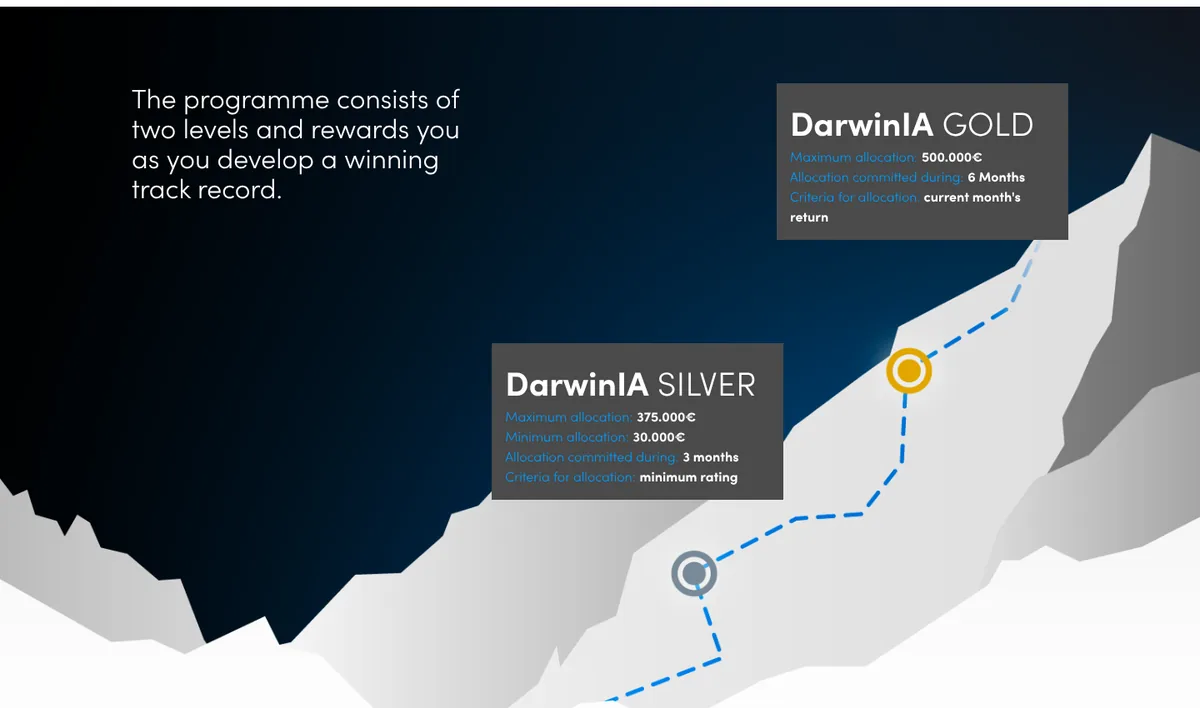
Monthly. A rating of at least 75 at month end earns a notional allocation of €30,000 to €375,000 that stays invested for 3 months.
- 5
DarwinIA GOLD
More than 8 months of history plus return/drawdown criteria: €50,000 to €500,000 for 6 months. The DARWIN is opened to real investors on Darwinex.
Money flows
6Performance fee
15% of the net profit on the allocation, only above the high-water mark. Calculated quarterly from the first allocation by default, monthly as an option.
- 7
Payout
After ID and bank verification, any time from €100 by bank transfer. Typically processed within 24 hours, per the help centre.
Optional purchases: Boosters (€25,000 to €200,000, time-limited) and Permanent Allocations (up to €100,000, no expiry). Both run alongside DarwinIA with their own high-water mark.
1. Subscription and virtual account
Before signing up you choose an account type and platform. CFD accounts on forex, indices and commodities run on MetaTrader 4, MetaTrader 5 and TradingView; stock, ETF and crypto CFDs and futures only on MT5. A CFD account starts with USD 100,000 of virtual equity, a futures account with USD 1M. Leverage matches an EU retail account: up to 1:30 on forex, 1:20 on indices and commodities, 1:5 on US stocks and ETFs, 1:1 on crypto.
Darwinex Zero stresses that this is a virtual, not a demo account: orders run on real servers with real latency and liquidity, only the money is not real. Important for EA traders: the platform page explicitly lists Expert Advisors for MT4 and MT5.
2. Calibration: not a test, but data collection
Before a DARWIN exists, the risk engine needs data. You need 25 "risk-equivalent" trading decisions over at least 15 trading days. There is no return target. A single position does not automatically count as one decision: Darwinex weights each position by leverage and holding time and relates it to the largest position. Someone trading equal-sized, short positions collects decisions faster than someone with one large and many small positions. Without trading activity the calibration lapses after 90 days. Once the criteria are met, the DARWIN is created the following Monday.
3. The DARWIN and the risk engine
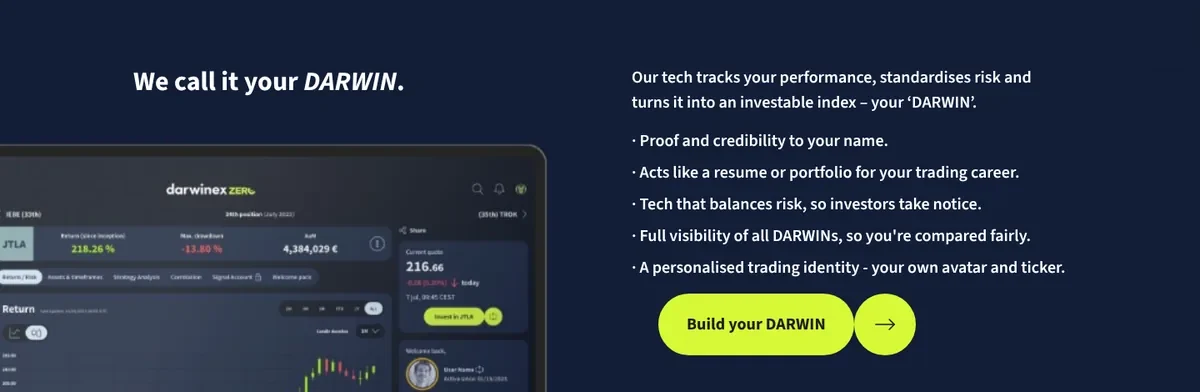
The DARWIN is not your account but a copy of your trades with its own position size. It starts at a quote of 100; a quote of 109.06 means +9.06% since inception, including execution and financing costs. The quote updates every 30 seconds, and nobody outside sees your individual trades.
The risk engine sizes positions so that every DARWIN runs at a target risk of 3.25 to 6.5% monthly value at risk. The reference is the risk of your last 45 days in the market. If a position carries too much leverage for too long, the engine partially closes it in the DARWIN: above a D-Leverage of 16.25 for positions under 30 minutes, 13 for 30 to 60 minutes and 9.75 for longer positions.
The consequence many miss: more leverage on the account does not mean more return in the DARWIN, and your DARWIN's return can differ markedly from your account's. Darwinex Zero itself says to focus on the DARWIN's performance, not the signal account. Allocations and fees depend only on the DARWIN.
4. DarwinIA SILVER: monthly allocation by rating
Once the DARWIN exists it automatically enters DarwinIA SILVER. At the end of each calendar month (market close on the last trading day) a rating is calculated from three inputs:
- current month return, weight 22%
- return of the previous five months plus the current month, weight 67%
- maximum drawdown over those six months, weight 11%
Bonus points are added for track record length: +1 from 6 months, +2 from 12, +3 from 18 months. A DARWIN with at least 75 at month end is guaranteed an allocation of €30,000 per the help centre; the top places receive more on a sliding scale, up to €375,000. Each allocation stays in the DARWIN for 3 months, so three qualifying months in a row mean up to three allocations at once.
How often that happens, Darwinex says itself: darwinex.com states that in SILVER about 15% of participants receive an allocation each month. DARWINs from Darwinex and Darwinex Zero compete in the same ranking.
Conditions that trip people up without them noticing: the DARWIN needs at least one trade in the current or previous month, and its correlation with other users' DARWINs must be below 0.95, with your own DARWINs below 0.5. Otherwise only the DARWIN with the higher six-month return takes part. A DARWIN excluded for correlation with a rating above 75 receives a credit worth the next monthly subscription.
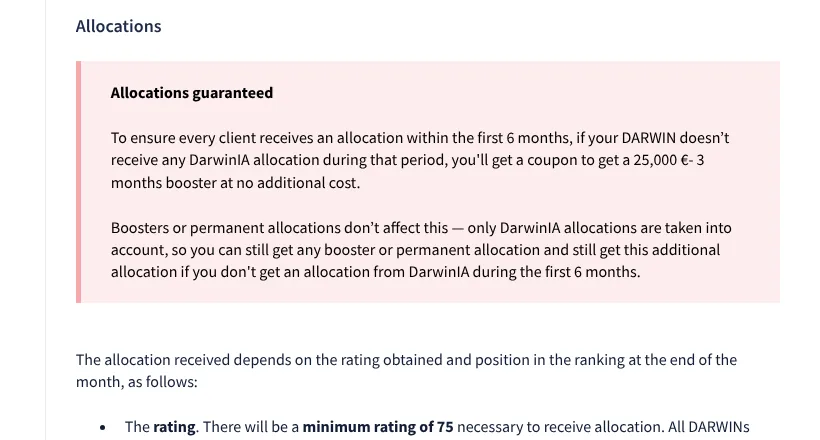
If a DARWIN receives no DarwinIA allocation at all in its first six months, you get a voucher for a €25,000 booster for three months.
5. DarwinIA GOLD and real investor capital
GOLD requires more than eight months of history and one of the return/drawdown conditions, for example a one-year return above 20% with a return-to-drawdown ratio above 2.5 (25 to 40% for two to five years). Allocations are larger (€50,000 to €500,000) and last 6 months, but the ranking counts only the current month's return and only the top receives anything. If the DARWIN no longer meets the criteria, it drops back to SILVER the following month.
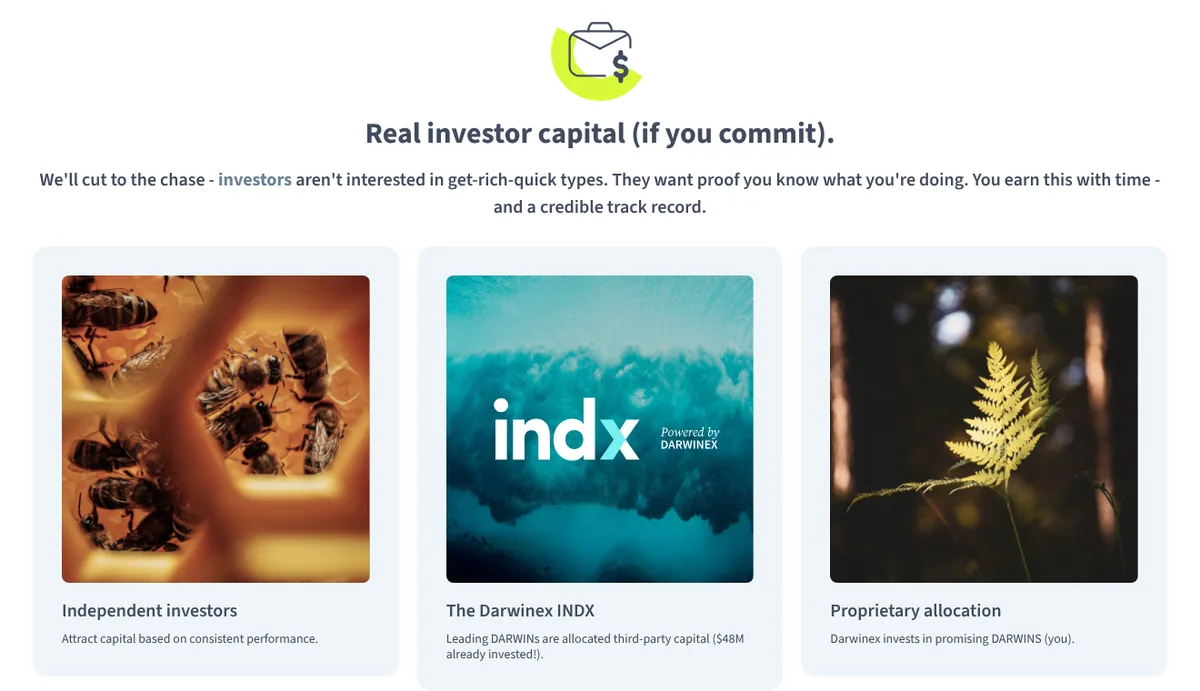
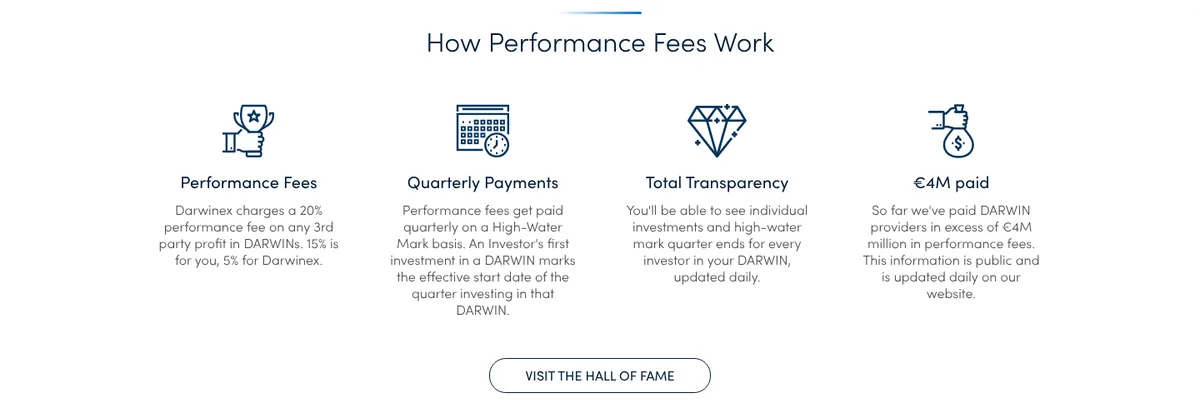
With GOLD the DARWIN is also published on Darwinex's investor platform. Investors there pay a 20% performance fee, of which 15% goes to you and 5% to Darwinex, quarterly on a high-water-mark basis. The DARWIN stays open to investors even if it later drops out of GOLD.

The "success" area: what the leaderboards show and what they do not
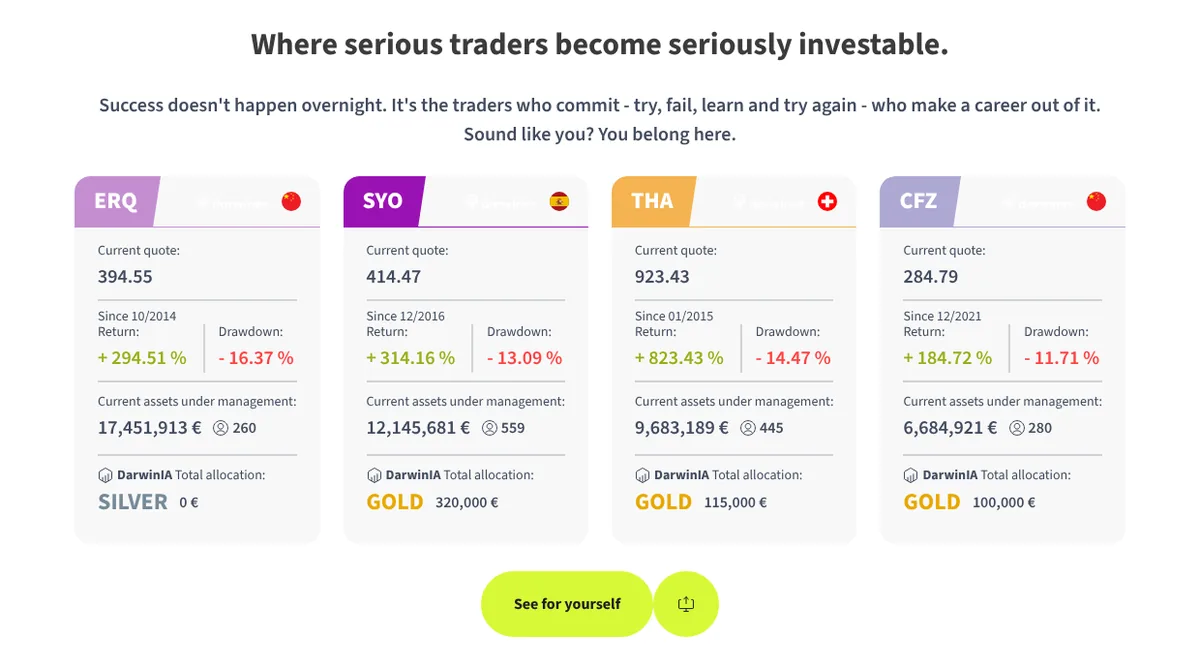
On the home page and under "All DARWINs" Darwinex Zero shows the DARWINs with the most capital under management, with return since inception, maximum drawdown and total DarwinIA allocation. This is real, public data, but a selection of the largest: on 3 Nov 2026 the list held 6,902 DARWINs, sorted by capital under management. The four cards on the home page carry three-letter tickers and run since 2014 to 2021. Per the help centre, Darwinex DARWINs have three letters and Darwinex Zero DARWINs four; the leaders shown are therefore strategies from Darwinex live accounts, not from Zero subscribers. What a typical new Zero member achieves cannot be read from them.
Costs
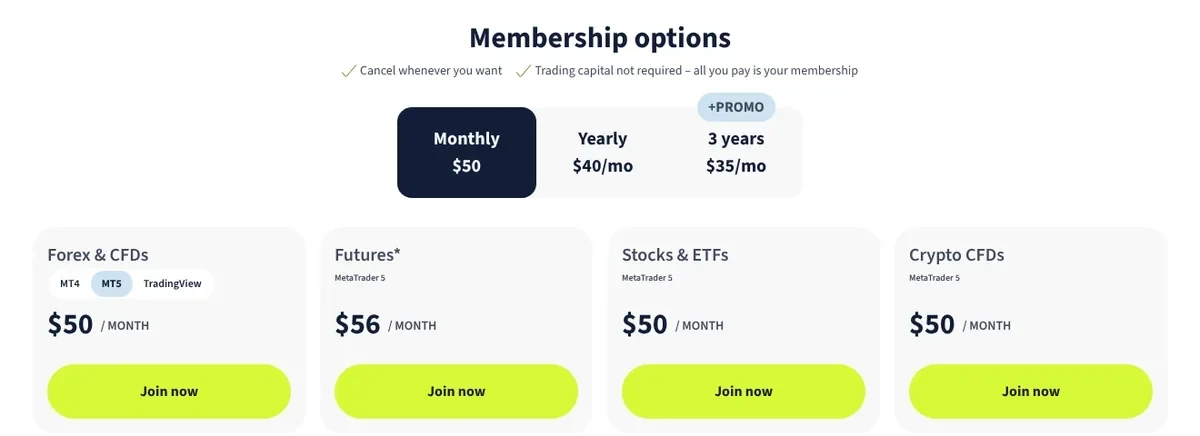
The price table in the help centre (as of 3 Nov 2026) lists for new sign-ups:
| Account type | Europe & UK | Rest of the world |
|---|---|---|
| CFDs (forex, indices, commodities) | €45 / month | USD 50 / month |
| Futures | €50 / month | USD 56 / month |
| Cash stocks & ETFs | €45 / month | USD 50 / month |
| Crypto CFDs | €45 / month | USD 50 / month |
| One-year pack, CFD | €420 | USD 480 |
| Three-year pack, CFD | €1,080 | USD 1,260 |
Optional items on top:
- Restart of the account: one monthly fee. The track record, the DARWIN and all allocations (bought ones included) are lost.
- Monthly HWM (monthly instead of quarterly settlement): extra charge, per the table €50 instead of €45 a month for CFD accounts. Only selectable within 14 days of starting or restarting the subscription.
- Boosters: purchased, time-limited allocations of €25,000 to €200,000 for three months to three years. A €100,000 booster for three months costs €525 per the table, less with a return target. At most €500,000 at a time.
- Permanent Allocation: non-expiring allocation up to €100,000, e.g. €50,000 for €900 instantly or €270 with a 10% return target.
You pay by card, PayPal or from fees not yet withdrawn. You can cancel any time, effective at the end of the billing period. Per the refund policy there is a refund if you cancel within 14 days of the first subscription and have not placed any trade. A note on accuracy: the teaser of the help centre article mentions €38 a month in one place, the table below it €45, the home page "from €45"; the price in the sign-up flow is what counts.
Performance fee: how it is calculated
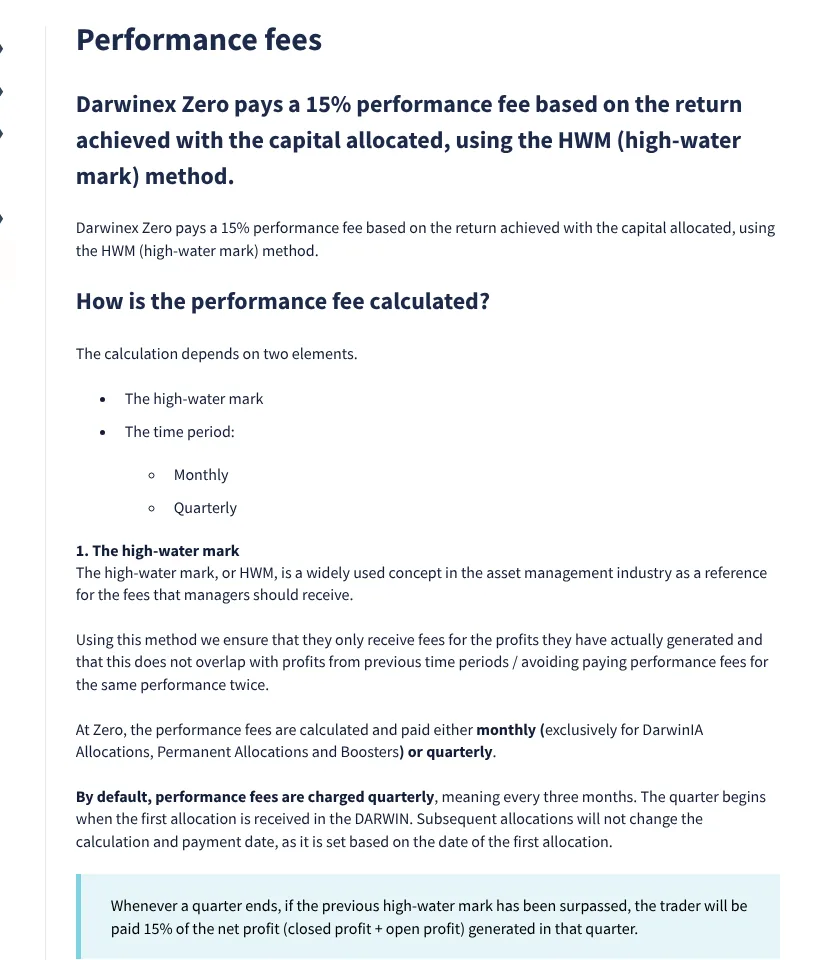
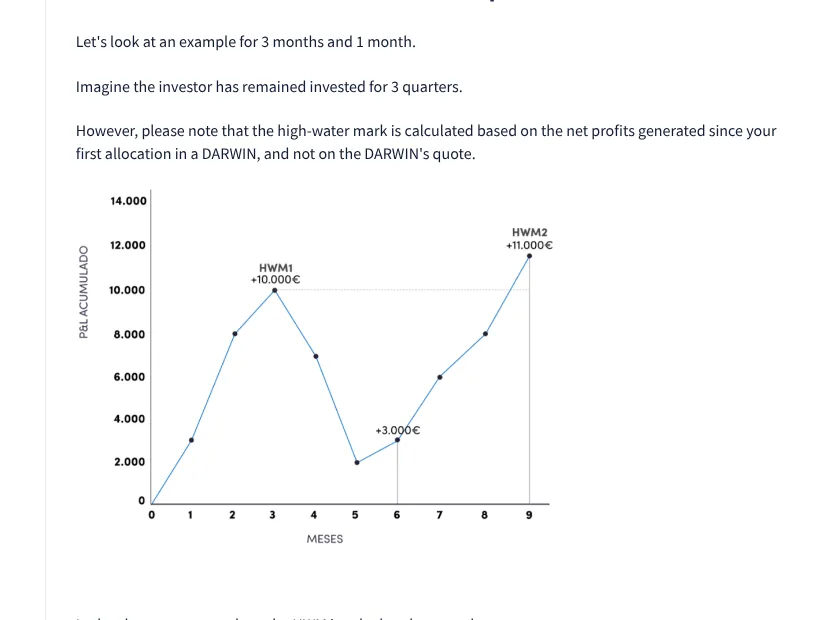
The fee is 15% of the net profit (closed plus open profit) the DARWIN makes on the allocation, measured against a high-water mark (HWM). You are only paid for new highs, never twice for the same gain. Each allocation type (DarwinIA, Booster, Permanent) has its own HWM.
What matters is the base. The 15% refers to the notional allocation, for example €30,000, not to the USD 100,000 account and not to your account's return.
Worked example, not a forecast
Scenario A: DARWIN +4% in the quarter
- Notional allocation (SILVER)
- €30,000
- Profit on the allocation
- €1,200
- Performance fee 15%
- +€180
- Subscription, 3 months × €45
- −€135
Net for the quarter+€45
Scenario B: DARWIN −3% in the quarter
- Notional allocation (SILVER)
- €30,000
- Result on the allocation
- −€900 (notional)
- Performance fee
- €0
- Subscription, 3 months × €45
- −€135
Net for the quarter−€135
You do not pay the notional loss. It does move the high-water mark: a fee is due again only once it is recovered. When an allocation expires in loss, Darwinex Zero resets the loss under its own rules (fully, or capped at −5% when a new allocation arrives).
For DarwinIA allocations there is an HWM reset that works in your favour: if all allocations expire in loss, the next one starts at zero again. If you receive a new allocation while the running ones are more than 5% down, the accumulated loss is capped at −5%. Boosters have no reset.
When it pays out: the cycle
Diagram
- StartAllocation at month end
- Month 1running
- Month 2running
- Month 3Fee 15%
- StartAllocation at month end
- Month 1Fee 15%
- Month 2Fee 15%
- Month 3Fee 15%
1Credit
The fee shows under Payments, Earnings. Fees you have not withdrawn can also pay the subscription.
2Request
Withdraw any time from €100, after ID verification and a verified bank account.
3Transfer
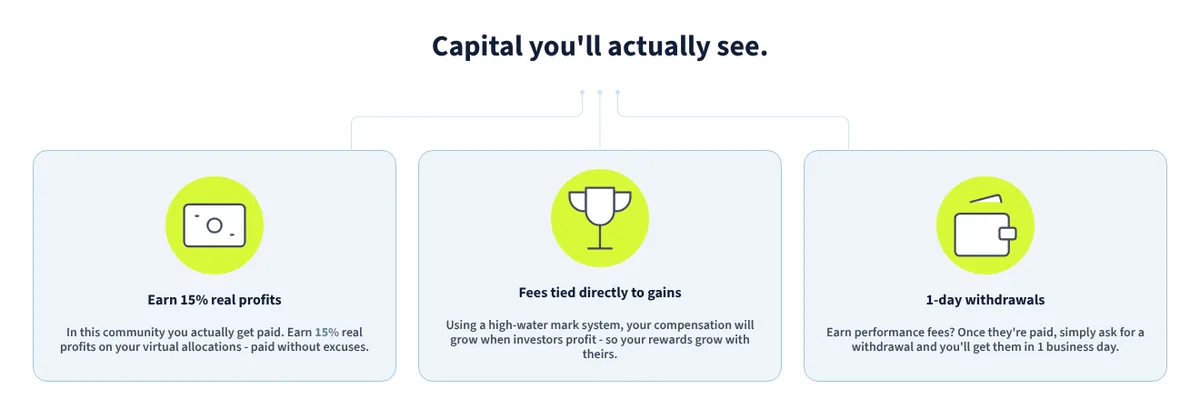
Typically processed within 24 hours per the help centre, 1 business day per the website. Darwinex Zero charges no transfer fee.
Quarterly is the default. The quarter starts with the first allocation to the DARWIN; later allocations do not move this date. If the DARWIN is above the last HWM at quarter end, 15% of the quarter's profit is credited.
Monthly as an option. With the monthly HWM, DarwinIA, Booster and Permanent allocations are settled every month; a month's loss is not carried into the next settlement, the mark starts afresh each month. Investor capital (from GOLD) is always settled quarterly; if an investor exits earlier, their fee is retained and paid at quarter end.
How it pays out
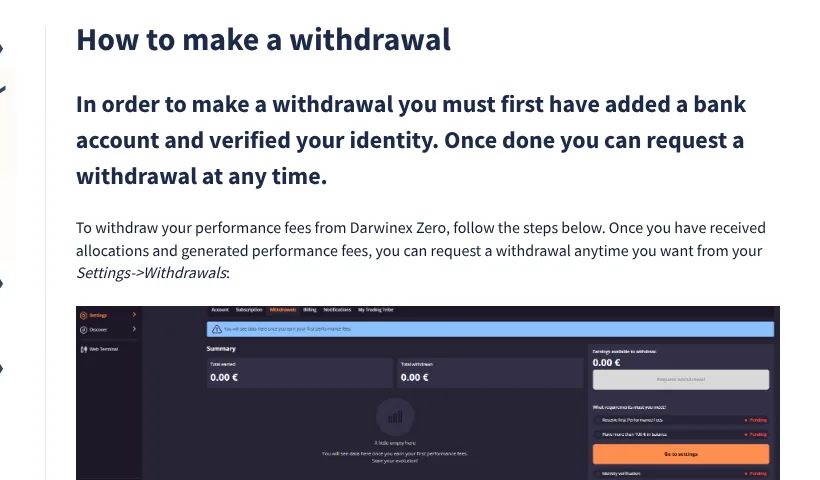
You request a payout under Settings, Withdrawals. Before that you need to, once:
- verify your identity (name, ID number, address, country of residence, upload of ID card, passport or driving licence),
- add a bank account and prove it with a bank statement (IBAN and account holder's name). Review typically takes up to 24 hours per the help centre.
After that you can withdraw at any time, from €100. The transfer is in euros; for an account in another currency your bank converts at its rate. Darwinex Zero charges no fee and typically processes within 24 hours per the help centre; weekends and public holidays can take longer. If you also hold a live Darwinex account, you can send the fees to the Darwinex wallet; EU clients only if they have deposited there before. Taxes are your responsibility: Darwinex Zero explicitly gives no tax advice.
Rules: what exists and what does not
What does not exist: no profit target, no daily loss limit, no maximum drawdown that ends the account, no minimum number of trading days after calibration. Darwinex Zero puts it as "no restrictions on instruments, volume, or duration, and no specific return or drawdown targets".
What does exist and can cost you money:
- Rating instead of rule breach. A large drawdown ends nothing, but it lowers the six-month rating and with it the chance of allocations for months.
- Risk engine. Excessive leverage or positions held too long are reduced in the DARWIN.
- Activity. At least one trade in the current or previous month, otherwise no DarwinIA participation.
- Correlation and independence. The Terms of Business require your signal to be developed independently and not to come from a common source, explicitly naming a commercial EA sold to multiple users. If your DARWIN is excessively correlated with another user's, payouts from allocations can be declared null and void (clause 5.3). Opposite trades across several accounts are prohibited (2.2.4).
- Rights to your signal. You grant Darwinex Zero a perpetual, irrevocable licence to your signals and allow your username and signal history to be shown publicly (2.2.1, 2.2.3).
Who runs Darwinex Zero and how it is regulated
Darwinex Zero is a trading name of Tradeslide Technologies Ltd, London, company number 14398381. Per the site footer this company is an introducer appointed representative of Tradeslide Trading Tech Ltd, authorised by the UK FCA (FRN 586466) as Darwinex. The broker Darwinex is also regulated in the EU by the Spanish CNMV.
Per the help centre the Zero service itself is not regulated: it holds no client money, you trade a virtual account and supply signals. The Terms of Business state plainly that under this agreement you are not a client in the regulatory sense and do not have those protections. Darwinex Zero may also change the service or terminate it with seven days' notice.
If you later want to continue with your own money, you can migrate the DARWIN to Darwinex: at least USD/EUR/GBP 1,000 deposit, CFD accounts only, and the DARWIN must have a DarwinIA allocation or at least 2% return over the last five months. More on the broker in our Darwinex review.
Darwinex Zero vs prop challenge vs instant funding
The difference lies less in the percentages than in the base and the cost model. A prop firm pays a high share on a large simulated account but ends it at the first rule breach. Darwinex Zero pays a small share on an allocation you have to earn anew every month, and in return never ends your account. And it costs every month for as long as you stay.
| Darwinex Zero | Prop challenge (FTMO 2-Step) | Instant funding (FTMO Instant) | |
|---|---|---|---|
| Cost | Subscription from €45/month (EU/UK) for as long as you stay | One-time fee €89 to €1,080, refunded with the first reward | One-time fee €169 to €2,999, not refunded |
| Evaluation | None. Calibration: 25 decisions, at least 15 trading days | 10% target, then 5%, at least 4 trading days | None, account live on purchase |
| Loss limits | No daily or overall limit. The risk engine scales the DARWIN | 5% daily, 10% overall | 3% daily, 10% overall, 30% consistency rule |
| On a breach | No account loss, a poor rating means smaller or no allocations | Account ends, new challenge needed | Account ends, new purchase needed |
| Profit share | 15% of the profit on the notional allocation | up to 90% of the account profit | 90% of the account profit |
| Payout rhythm | Quarterly from the first allocation, monthly as an option | Request from day 14 after the first trade, review 1 to 2 business days | as 2-Step |
| Path to real capital | From GOLD, investor money on Darwinex, 15% fee | Simulated capital, scaling plan | Simulated capital |
All five ways of trading with outside capital, including copy trading and your own account, are covered in our guide Funding models explained. How a classic challenge works with an EA is in Passing a prop firm challenge with an EA, and for the reference provider see our FTMO review.
Who Darwinex Zero suits and who it does not
More suitable if you
- have your own strategy that delivers steady returns with limited drawdown over months (the rating weights the six-month return at 67%),
- want to build a public, verified track record, for example to manage investor money later without needing a licence yourself,
- dislike daily loss limits and account terminations and prefer to progress slowly,
- want to trade with Darwinex anyway and use Zero as a low-cost run-up without your own capital.
Less suitable if you
- expect quick, large payouts: 15% on €30,000 is often less than the subscription at realistic returns,
- want to run a purchased EA that many others use too (correlation rule, clause 5.3),
- run a strategy with rare, large wins: the risk engine and the rating reward consistency,
- only want to test for a month or two: calibration, a six-month rating and GOLD after eight months at the earliest make Darwinex Zero a project of a year or more.
Risks and pitfalls
- The subscription is certain, the fee is not. Work it out over a year: €540 of subscription (or €420 on the yearly pack) against fees that only arise with an allocation and profit above the HWM.
- The allocation is notional. Darwinex Zero itself says it is not real capital and can therefore be granted more freely. Real money only comes via investors from GOLD.
- DARWIN ≠ account. The risk engine can shrink your return in the DARWIN; a nice account result is not yet a fee.
- A restart wipes everything. A restart costs a monthly fee and also the DARWIN, the history and all allocations, bought ones included.
- Bought allocations are an extra business. Boosters and Permanent Allocations cost money up front; whether fees earn it back depends solely on future returns.
- No regulatory protection for the Zero agreement, and one-sided rights for the provider to change it (see above).
- Leaderboards show the winners. The DARWINs on the home page are the largest of almost 7,000, not the average.
For EA traders: what to check first
- Independence: does the EA run for many other buyers? Then there is a correlation risk up to payouts being voided. Own developments or heavily customised setups have the edge here.
- Holding time and leverage: check in the backtest how long positions stay open and what leverage builds up; grid and martingale baskets with long holding times hit the D-Leverage limits. Background in Grid and martingale EAs: the risks.
- Consistency: the rating measures monthly and six-month return and drawdown. The metrics are explained in Trading metrics: drawdown, profit factor.
- Operations: an EA on a virtual account needs a stable VPS just as on a live account.
Sources
All pages accessed on 3 Nov 2026; screenshots from the same day.
- darwinexzero.com: home page, "From €45/month", 15% performance fees, MT4/MT5/TradingView, operator and FCA note in the footer
- darwinexzero.com/pricing: memberships, inclusions, restarts from USD 50
- darwinexzero.com/your-path-to-capital: calibration, SILVER, GOLD after at least eight months
- darwinexzero.com/your-darwin-index: DARWIN, starting quote 100, risk engine
- darwinexzero.com/capital-allocation: capital sources, high-water mark, one-day withdrawals
- darwinexzero.com/all-darwins: 6,902 DARWINs, sorted by capital under management
- darwinexzero.com/trading-platforms: TradingView, MT4, MT5, Expert Advisors
- darwinexzero.com/support: FAQ on starting equity, leverage, fees, withdrawals from €100, introducer appointed representative status
- Help centre: What is Zero?, How much does it cost?, Is Zero regulated?, Differences to other funding programs, Calibration stage, DarwinIA SILVER, DarwinIA GOLD, DarwinIA Rating, Type of allocations, Understanding Zero capital allocations, Performance fees, Monthly HWM, Boosters, Permanent allocations, Allocations & earnings, How to make a withdrawal, Investor capital, Risk engine, What is a DARWIN?, Leverage, Accounts & assets, Reset, Migration to Darwinex
- Terms of Business (user status, clauses 2.2, 5.3, 13) and Refund Policy
- darwinex.com: about 15% of SILVER participants receive an allocation each month
- darwinex.com/trading/performance-fees: 20% performance fee, 15% to the trader, quarterly
- darwinex.com/trading/darwinia-seed-allocation-programme: SILVER and GOLD levels
- FTMO comparison figures: ftmo.com/en/2-step-challenge, ftmo.com/en/instant-account, reward withdrawal, fee refund
What the sources do not state: how many Zero members have ever received a performance fee, and how large fees are on average. We therefore give no figure for either.