Verdict in brief
Dawnbreak is a session range breakout for MetaTrader 5: it measures the high and low of a fixed time window, places a BuyStop order above and a SellStop order below, and the first to fill wins. One trade per day and chart, a stop loss on every trade, no grid, no martingale. We read the full source code – the risk logic does what the listing promises.
What is missing is evidence. A real-money account at IC Markets has been trading since 5 Oct 2026 – after one week that is a start, not a track record, and it does not run the published example sets. The only MT5 backtest is the developer's own and covers gold only: +47.2% in 21 months at 18.3% drawdown, a profit factor of 1.24 – a thin edge. Our methodology weighs the missing live record most heavily. That is why Dawnbreak stands at 2.9/5 with a red light – the same yardstick we applied to Range Breakout EA (3.4, two public signals) and The ORB Master (2.6).
Disclosure
Dawnbreak is our own product: the operator of AlgoVerdict developed the EA and sells it on MQL5. We earn money from every sale. The link to the product page below is therefore not a partner link; it is labelled “our own product”.
To keep this conflict of interest from moving the grade, we committed to three things:
- Same weights, same traffic-light rules as for every other EA on the methodology page. No criterion was adjusted for this review.
- Evidence only where others would have to provide it too. We could read the source code because it is ours – it counts for strategy risk and usability, but not for the live track. A buyer does not see the code.
- Stricter when in doubt. Where a criterion sat between two values, we took the lower one.
How Dawnbreak trades
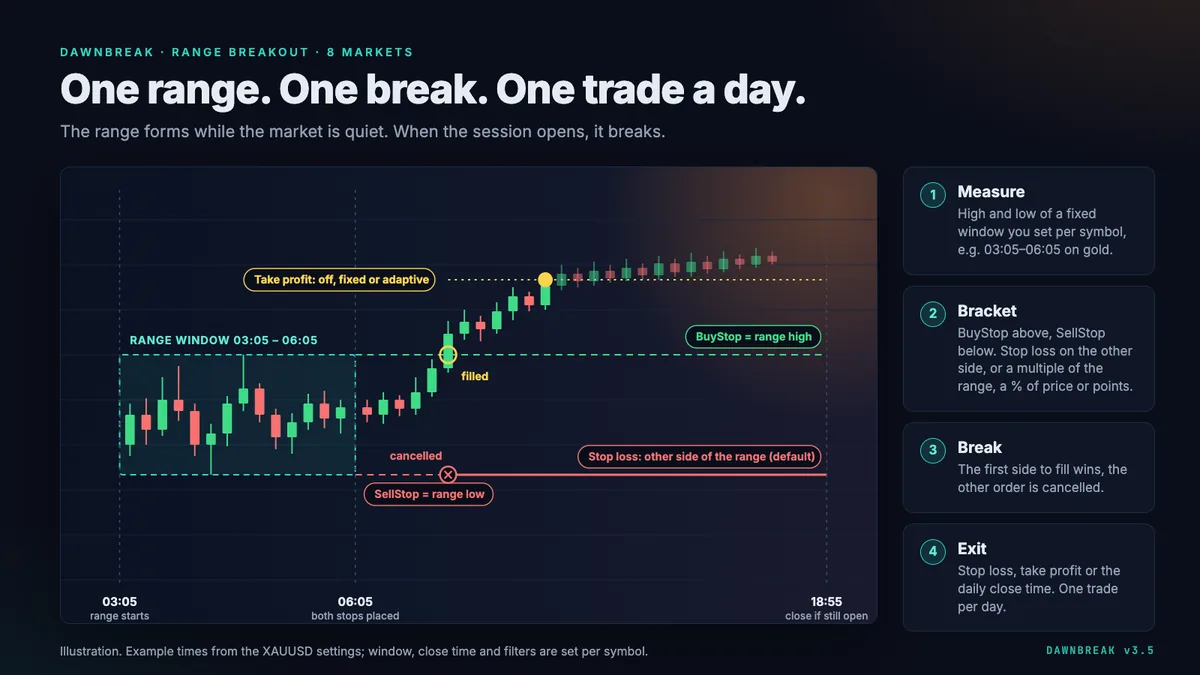
The animation above shows the strategy type schematically. In practice every trading day runs in four steps:
- Measure – high and low of a fixed window in server time, for example 03:05–06:05 on gold. After the window closes, the EA reads the range again from M1 history so that a missed tick cannot distort it.
- Bracket – BuyStop at the range high, SellStop at the range low, both with a stop loss and an expiry time.
- Break – the first order to fill wins and the other is deleted (one-cancels-other). If only one of the two orders can be placed, the EA withdraws that one too rather than trading one-sided.
- Exit – stop loss, take profit or the fixed close time. Anything still open then is closed.
Markets & set files
Example sets exist for eight markets: gold (XAUUSD, once without and once with the adaptive take profit), four currency pairs (EURUSD, GBPUSD, USDJPY, EURJPY), two indices (DE40, US30) and Bitcoin. All sets risk 1% of the balance per trade, place the stop at the opposite side of the range and use their own magic number, so several charts can run side by side on one account.
The most important limitation is stated in the listing itself: only gold has been tested so far. The windows for the other seven markets are starting values without a backtest of their own. An older window sweep of the predecessor “Janus Breakout” used different windows and does not carry over to these sets. Anyone who wants to trade EURJPY or DE40 has to check that market in the Strategy Tester and on a demo account first.
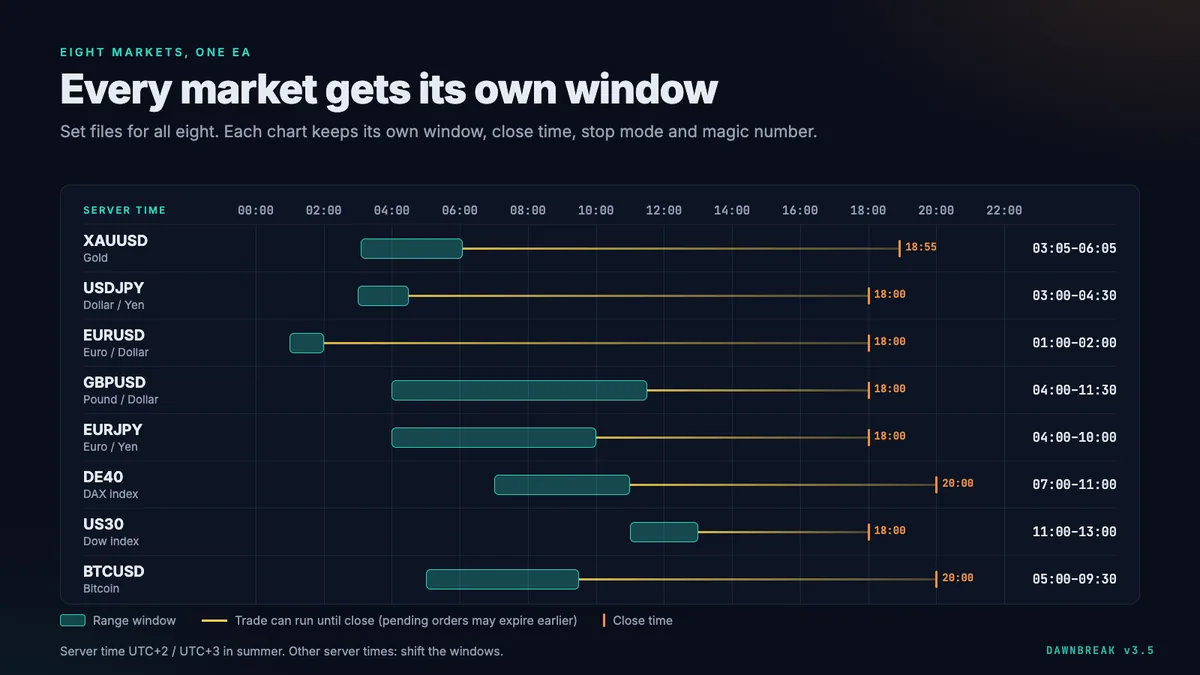
Two points from the set files that the listing does not highlight: only the two gold sets use a range filter (0.2–1.5% of price). In all nine sets the daily loss limit and the spread filter are switched off. On 1 Oct 2026 the sets announced in the listing were not yet visible; the developer posted them in the product comments on 7 Oct 2026, and they are identical to the nine files we read for this review.
Risk & stop logic (from the code)
This is Dawnbreak's strongest part, and we did not take it from the listing – we read it in the version 3.5 source code. Version 3.60, on sale since 7 Oct 2026, changes one detail only: the EA no longer tries to cancel an order the server is already filling, which removes harmless error lines from the log. We compared both files; trading logic and inputs are identical.
- Every order has a stop. Four modes: opposite side of the range (default), a multiple of the range, a percentage of price or fixed points. For every mode except the default, the EA refuses a stop value of zero at start-up.
- The lot size follows the stop. It is calculated from the risk amount and the stop distance – the wider of the two sides, so the risk still holds when one order had to be moved outward because of the broker's minimum distance.
- Round down, never up. If the calculated lot size is below the broker's minimum lot, the EA skips the day and says so in the log. Rounding up to the minimum lot would put more than the set risk on the table on those days.
- Margin cap. Before placing the orders the EA calculates the margin of the market order a stop turns into when it fills, and caps the lot size to 90% of the free margin. The broker's volume limit per direction is respected as well.
- One trade per day, even after a restart. The EA registers a fill immediately through the trade event, checks the day's deal history after a restart and deletes any leftover order. A second trade on the same day is not possible.
- No grid, no martingale. The lot size depends only on the balance and the stop, not on the last result, and there is no averaging logic.
The weaknesses are in the code, too:
- No account-wide cap. The daily loss limit, the losing-streak pause and the spread filter each work per chart – and are off in the example sets. Eight charts at 1% each can put up to 8% of the account at risk on the same day.
- Stop orders have no slippage limit. On price gaps, for example after the weekend or on news, the broker fills at the next available price. The real loss can then exceed the 1% that was set. There is no news filter.
- Risk from balance, not equity. With open losses on other charts, the EA still sizes from the higher balance.
- Fixed server time. The windows assume a broker on UTC+2/UTC+3. With a different server time you have to shift them yourself, and a window across midnight is not possible.
Adaptive take profit
Instead of a fixed target, Dawnbreak can learn one. After every breakout the EA measures how far price ran in the trade's direction – until the stop level or the session close, also after a target was already hit. The next target is the average of the last 30 measurements. Breakouts that never moved the right way count as zero, so the average is not made of winners only.
Until 30 values are collected, the EA paper-trades by default and places no orders; according to the listing that takes six to eight weeks. An optional floor and cap can be set as multiples of the range.
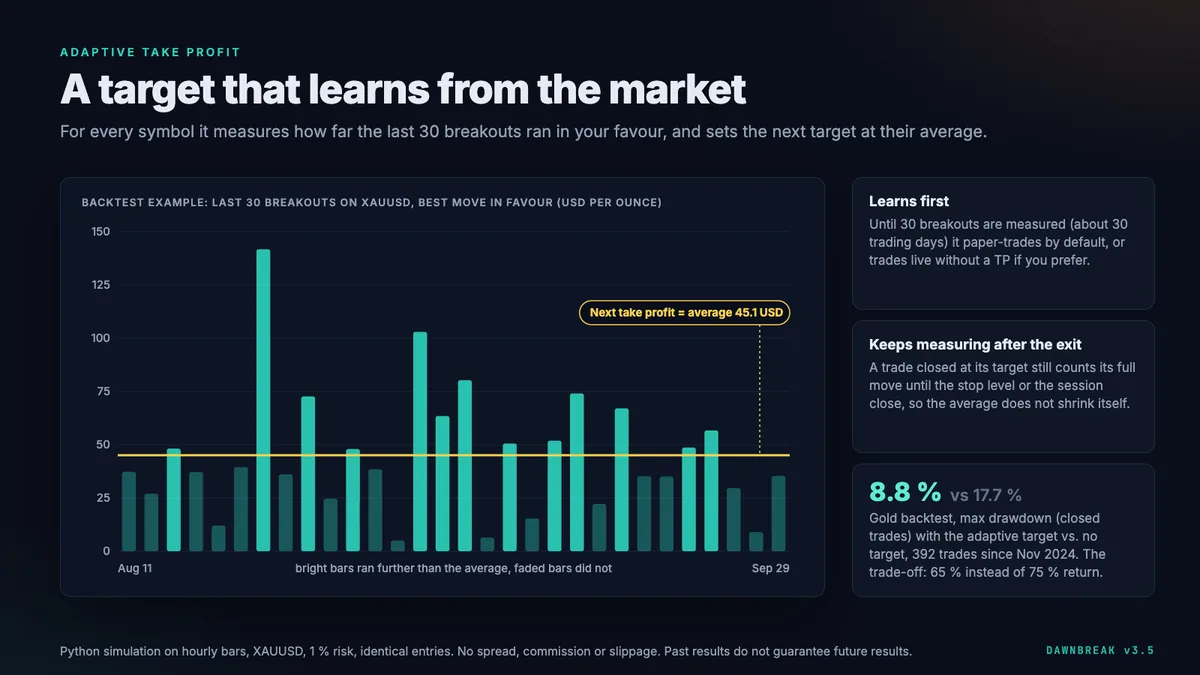
Limits worth knowing: a simple average reacts strongly to outliers – among the 30 example values in the graphic, one is around $142 and the average is $45.1. The learned values are stored in the terminal's global variables. Moving to a new terminal or VPS starts from zero unless they are carried over, and in the Strategy Tester every run starts without values – with paper trading on, the first 30 breakouts place no trades there.
Protection & dashboard
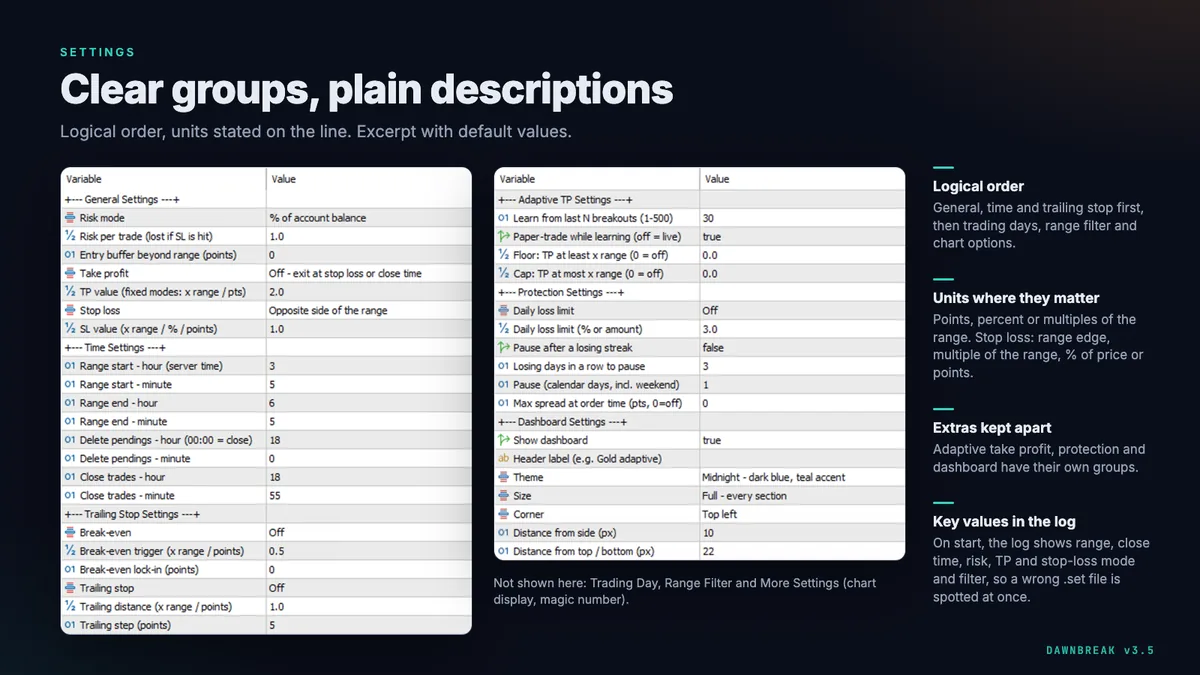
Besides the stop logic, Dawnbreak brings the usual tools: break-even and trailing stop (in points or as a multiple of the range), range filter, a daily loss limit that includes open losses, a pause after a losing streak, maximum spread and trading days. If both pending orders disappear before a fill – for example because another program deleted them – the EA re-places the bracket up to eight times a day.
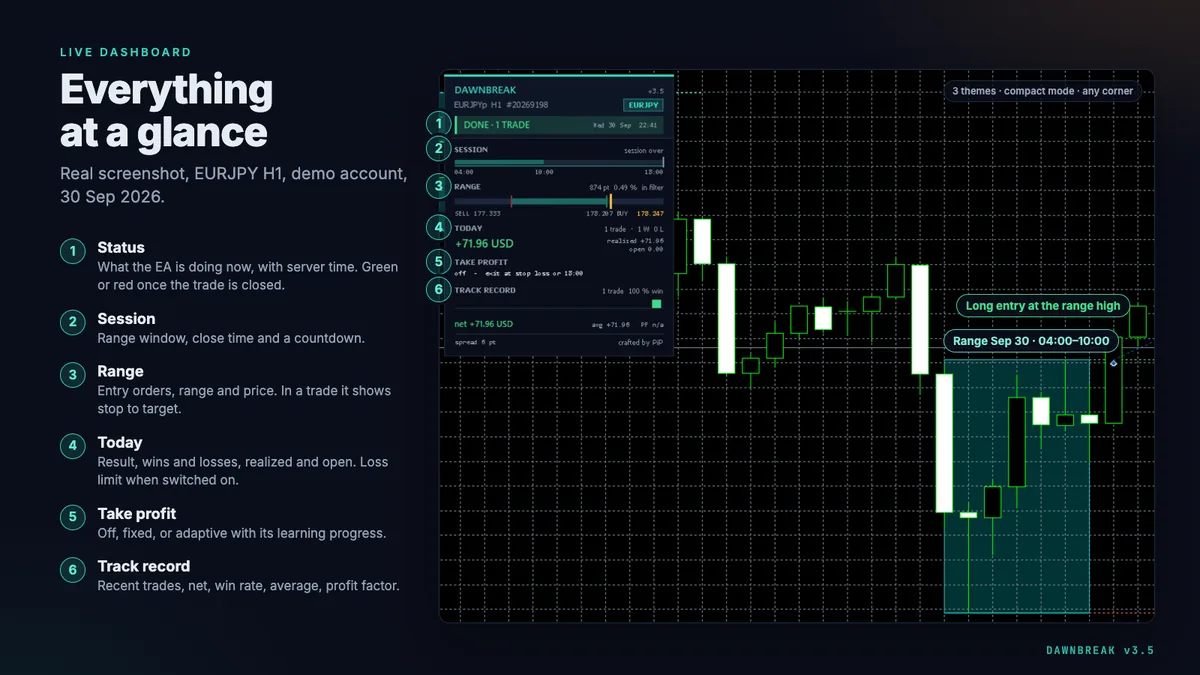
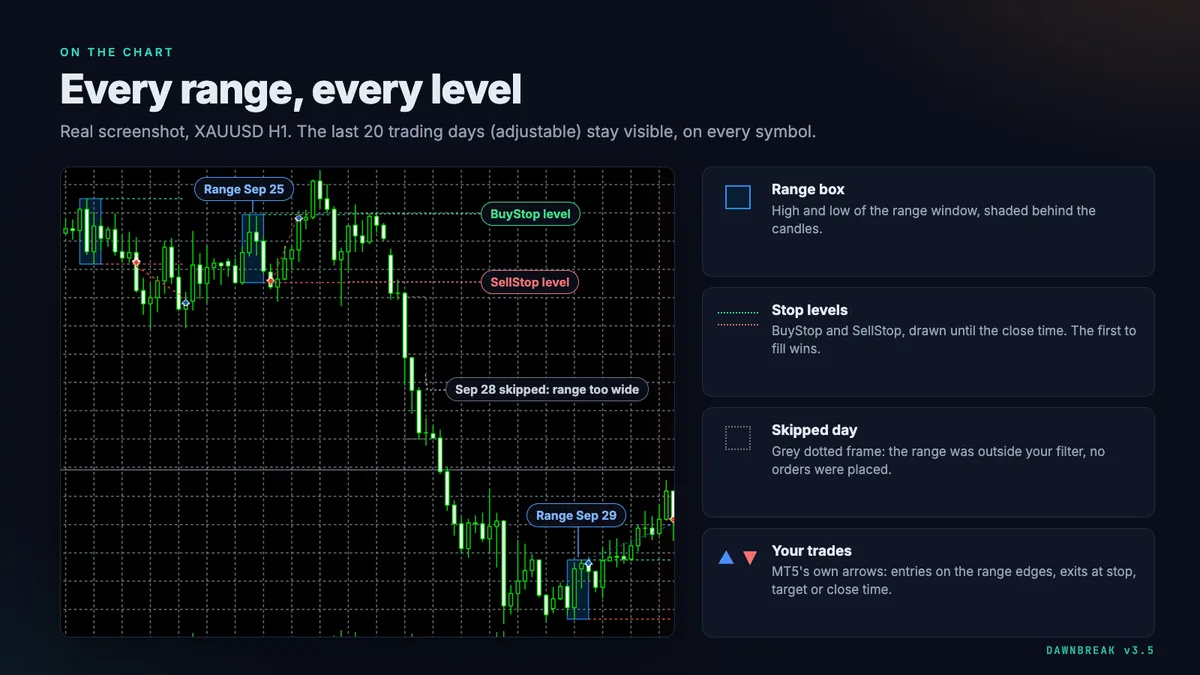
The dashboard shows status, a session timeline, range and price, today's result, the loss limit, the take profit and recent trades. The chart keeps the ranges of the last 20 trading days with their order levels; filtered days are marked. On start, the EA writes the key settings to the log, so a wrongly loaded set is spotted at once.
Backtest
There is one backtest in the MT5 Strategy Tester, and only for gold. The developer ran both public gold sets through the ATS Backtest Manager: XAUUSD, 1 Jan 2025 to 1 Oct 2026, every tick based on real ticks from Darwinex, random execution delay, $10,000 starting capital, leverage 1:100. Settings of the gold sets: 1% risk per trade, range 03:05–06:05, close 18:55, stop at the opposite side, range filter 0.2–1.5%.
| Gold set | Trades | Result | Max. drawdown | Profit factor |
|---|---|---|---|---|
| classic, no take profit | 403 | +47.2% | 18.3% | 1.24 |
| adaptive take profit | 380 | +23.1% | 12.3% | 1.16 |
Developer's backtest, MT5 real ticks (Darwinex), XAUUSD.
The classic figures are in the listing; the adaptive ones come from the developer's summary of the same run. Win rates: 47.9% and 53.7%. The adaptive set paper-trades its first 30 breakouts in the tester as well, so its result starts six to eight weeks later.
What the test shows – and what it does not:
- Real ticks instead of a proxy. Spreads come from the tick data, and the random delay simulates slower fills. The summary does not say whether a commission was charged.
- A thin edge. A profit factor of 1.24 means that for every dollar lost, $1.24 came back. Over 21 months that is +47.2% at 18.3% drawdown. A broker with wider spreads or more slippage on the stop orders can eat a large part of it.
- One market, one period. Twenty-one months in a strong gold phase; the other seven markets have not been tested in the Strategy Tester at all.
- Repeatable. The gold sets are public and the free demo runs in the Strategy Tester, so anyone can repeat the test with their own broker's ticks.
- The developer's own test. Like every vendor backtest, it counts in no evidence class for us.
An earlier Python study on hourly gold futures bars had shown +75% at 17.7% drawdown – without trading costs and with an approximated range window. The listing text now says the real-tick test replaces it, and quotes the lower figure – that counts in its favour.
Under our methodology, backtests earn no points for the live track. They feed into transparency – the repeatable real-tick test is why that score rose from 3.5 to 3.7.
Live status
Dawnbreak has been available on MQL5 since 1 Oct 2026. Since 5 Oct 2026 it has been trading a real-money account at IC Markets (Raw Trading Ltd, MT5): $4,300 deposited on 4 Oct 2026 in a single transfer, no other EA on the account until 11 Oct 2026, figures from the ATS Space Tracker. The account is run by the developer – that is, by us. We show it with a shortened account number, like every account in our EA park.
Our live account · figures from the tracker
As of 09 October 2026 · updated weekly
| Metric | DawnbreakLive · IC Markets · ••7728 |
|---|---|
| Shared account | no, runs alone |
| Deposit | $4,300.00 |
| First trade | 5 Oct 2026 |
| Last trade | 9 Oct 2026 |
| Run time | 5 days |
| Trades | 17 |
| Net | +$84.14 |
| Net as % of deposit | +2.0 % |
| Profit factor | 1.60 |
| Win rate | 58.8 % |
| Closed drawdown (this EA only) | 1.5 % · $64.28 |
| Max. drawdown per tracker (incl. open positions) | 2.81 % |
| Status | trading |
Cumulative closed P/L since 05 October 2026 – USD on the left, % of the deposit on the right
- Closed trades only; the maximum drawdown including open positions is in the table.
Source: our EA park, read from the ATS Space Tracker (Waterline). Account numbers shortened.
Follow it live. The account was freshly started. Since 11 Oct 2026 it also runs as a public MQL5 signal “Range Breakout Dawnbreak” – anyone can see every trade there live, with balance, drawdown and the full trading history from day one. The signal shows the whole account, though: from 12 Oct 2026 it also lists the index trades of LongRunner and Second Wind, and from then on its balance and drawdown reflect all three EAs, not Dawnbreak alone.
What the account runs. Not the published example sets, and still version 3.5 – 3.60 does not change the trading logic. Until 11 Oct 2026 Dawnbreak ran there alone, on four markets – gold, EURJPY, USDJPY and Bitcoin – with a risk per trade set by hand for each market and without a take profit: a trade ended at the stop or at the fixed close time. Since the evening of 11 Oct 2026 it has been a portfolio account with three of our own EAs. Dawnbreak now trades seven markets – gold, EURJPY, USDJPY, Bitcoin, GBPUSD, US30 and DE40 – with a fixed $50 risk per trade, about 1.2% of the deposit. Time windows and stops follow a reference setup: a stop of 1% of price on gold, GBPUSD, US30, DE40 and USDJPY, and 1 × the range on EURJPY and Bitcoin. The published example sets, by contrast, risk 1% of the balance per trade, place the stop at the opposite side of the range and cover eight markets. Next to it run LongRunner, a daily long trade on US30, USTEC and DE40 that closes before the rollover, and Second Wind, a “Turnaround Tuesday” trade from Monday to Tuesday on the same three indices – both at 0.10 lot each and without a stop loss, first trades from Monday, 12 Oct 2026. The account therefore shows how Dawnbreak behaves on a real broker server, not what the example sets would have made.
Only Dawnbreak is counted. The table above and our figures below still contain Dawnbreak trades only – separated from the other EAs on the account by magic number. The MQL5 signal, by contrast, shows the whole account.
How we read the figures (as of 9 Oct 2026). 17 closed trades in five trading days, a net profit of $84.14 or 2.0% of the deposit, profit factor 1.60, 10 winners and 7 losers. Two trades ended at the stop: gold on 5 Oct with a loss of $47.62 and EURJPY on 9 Oct with a loss of $48.40 – each about 1.1% of the balance at the time. The tracker measures a maximum drawdown of 2.81% including open positions. By market, Bitcoin made $42.14, EURJPY $40.54 and gold $11.07; USDJPY lost $9.61. After a high of $130.16 in profit on 8 Oct, the account gave back $46.02 on 9 Oct. Five trading days say nothing about the edge – a single bad week can turn every one of these figures around.
Before the live start the developer supplied two screenshots from 30 Sep 2026, both from BlackBull charts with EA version 3.2: one EURJPY trade at +$71.96 on a demo account and one US30 trade at +$8.00, where the screenshot does not show the account type. They show that the EA measures the range on a broker server, places the bracket and closes a trade cleanly – not a result. Two trades on one day, on a demo account, with an older version: under our methodology that is evidence class C and earns no points. The EURJPY day is the one in the listing graphic in the dashboard section above.
Why the live track still stands at 1.0. One week of trading is not a track record. The account is the developer's own: for any other EA that would be a record kept by the vendor, and we apply the same standard to ourselves. And it does not run the sets buyers get. Before the start we committed to re-rating the live track only after three months on real money – in January 2027 at the earliest. Green is possible after twelve months on a real-money account at the earliest – the same threshold as for the recommendation list in the EA hub.
Costs & capital needed
The price is low: on 8 Oct 2026 the product page showed a launch price of $99 for the first ten copies, then $149 and a final price of $199, with ten activations and a free demo for the Strategy Tester. There is also a one-month rent for $30 (11 Oct 2026). For comparison: Range Breakout EA costs $649, The ORB Master $499.
The account is the expensive part. Because the stop sits at the opposite side of the range, it is wide on gold: with ranges of $20 to $75 and 1% risk, the listing says you need about $7,500 or more so that the minimum lot of 0.01 does not risk more than 1%. Below that, the EA skips days with a wide range. Anyone running several markets in parallel has to add up the risk – and the terminal needs a stable connection during the session, which in practice means a VPS.
Who it suits – and who it does not
Suitable for traders who want to run a transparent breakout with a hard stop themselves, use the Strategy Tester and are willing to check a market on a demo account first. The logic fits prop-firm accounts in principle (one trade, fixed stop, adjustable daily loss limit), but you have to switch the limit on yourself.
Not suitable if a proven track record is a requirement – the live account is only days old. Also not for small accounts on gold, for traders who want to run eight charts at 1% each without limiting the total risk, and for anyone deriving an expected return from the backtest.
How the grade is built
| Criterion (weight) | Score | Reason |
|---|---|---|
| Strategy risk (20%) | 3.7 | Stop on every trade, one trade per day, lot never rounded up, margin cap – proven in the code. Deductions for the missing account-wide cap, the gap risk of stop orders and untested markets. Same level as comparable breakout EAs with a hard stop; the developer's real-tick test (18.3% drawdown at 1% risk on gold) fits it. |
| Live track record (25%) | 1.0 | Real-money account since 5 Oct 2026, but only one week of trading, run by the developer and with other settings than the example sets. As announced, we re-rate the live track after three months on real money; until then it stays at 1.0. |
| Transparency (20%) | 3.7 | Real-tick backtest with stated settings and public gold sets – buyers can repeat it with the free demo; the listing replaced the higher proxy figures with the lower ones. Capital needed and risk stacking stated openly. Deductions: the developer's own test without a stated commission, only gold tested, and the live account runs other settings than the published sets. Up from 3.5. |
| Value (15%) | 3.6 | $99 launch price for ten copies, $199 final price, free demo – cheap. We rate the final price; the value behind it is unproven, and a real-tick profit factor of 1.24 leaves a thin edge. |
| Usability (10%) | 3.6 | Clear inputs, dashboard, settings in the log, restart-safe. Deductions for the manual server-time adjustment, the capital needed on gold and the adaptive target's paper phase, which restarts with every terminal move. |
| Broker independence (10%) | 3.0 | Depends on server time, symbol names and pending orders with expiry; the real-tick test used one broker's ticks, and at a profit factor of 1.24 spread differences between brokers matter. |
Weighted, that gives 2.9 out of 5. Under our rules a grade below 3.0 means a red light. That is not a verdict on the code but on the evidence – and it is exactly how we would rate someone else's EA with the same evidence.
Bottom line
Technically, Dawnbreak is a cleanly built breakout EA with an honest listing and a fair price, and the real-tick backtest shows a modest edge on gold. That is all that can be said today. Only a longer real-money record will answer the return question; the account that started on 5 Oct 2026 needs months for that, not days. Anyone who wants to try it anyway should start with the demo in the Strategy Tester, then use a demo account and run a single market with the gold set and the daily loss limit switched on.
MQL5 product page· $199 (launch price $99)Our own product · not a partner link, we earn from salesSources
- MQL5 product page Dawnbreak Session Range Breakout: price ladder $99/$149/$199, version 3.60 of 7 Oct 2026, real-tick backtest in the description, no reviews (retrieved 8 Oct 2026); on 1 Oct 2026: $199 or $30 rent, version 3.50, no reviews and no comments.
- Source code Dawnbreak_v3.5.mq5 – from the developer, not public, read in full by us (1 Oct 2026); version 3.6 compared with it (9 Oct 2026).
- Nine example set files, version 3.5 (1 Oct 2026) – identical to the files posted in the product comments on 7 Oct 2026.
- Backtest summary of the developer: MT5 Strategy Tester via the ATS Backtest Manager, XAUUSD, Darwinex real ticks, both public gold sets (4 Oct 2026).
- Raw data of the earlier Python gold backtest and the 30 example breakouts, recalculated by us (1 Oct 2026) – replaced by the real-tick test.
- Two screenshots BlackBull EURJPY and US30 from 30 Sep 2026.
- MQL5 signal “Range Breakout Dawnbreak”: public signal of the same real-money account, created on 11 Oct 2026; it shows the whole account, so from 12 Oct 2026 it includes LongRunner and Second Wind.
- ATS Space Tracker, real-money account ••7728 at IC Markets: deposit, closed trades, profit factor and drawdown (read 9 Oct 2026).
- Comparison values: our reviews of Range Breakout EA and The ORB Master.