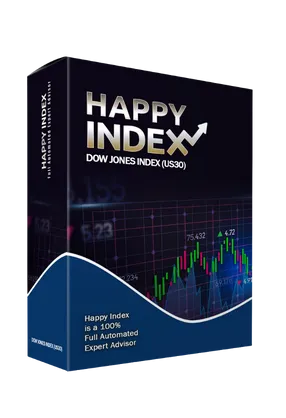
What Happy Index Is
Happy Index by Happy Forex trades only the Dow Jones Index (US30) on M5, M15 or M30. Entries come from trend analysis with multiple confirmations, an economic-calendar filter pauses new trades around important US releases, and according to the product page every position carries a stop-loss. AlgoTradingSpace sells it for €329 one-time (ATS product page) and — despite the stop-loss promise — lists it under “grid”.
The Live Data
ATS runs Happy Index on its own live account at BlackBull, started with $1,000 (as of 30.09.2026):
- +83.3% in 282 days, +8.3% per month on average
- Profit factor 2.82 on 187 trades
- Max floating loss -20.5%, max drawdown per ATS statistics 20.6%
- $800 withdrawn, balance afterwards just over $1,033
That is the strongest monthly return among the EAs we add in this round — and the withdrawals show it is not just a paper gain.
Strategy & Risk
Two figures do not quite fit together: a stop-loss on every position and a maximum open loss of a fifth of the account. Either the stops sit far away or several positions run at once — the ATS grid classification points to the latter. Our methodology works with the measured value: 20.5% gives a strategy risk of 3.2.
Then there is concentration risk. US30 is a single stock index; in a sell-off like 2020 or 2022 it falls fast and deep, and 282 days contain no such phase. Index EAs also depend more on the broker than forex EAs: spread, contract size and trading hours for US30 differ from house to house. We have seen only one account at one broker — hence 3.2 for broker independence. Which brokers offer indices cheaply is covered in the EA broker comparison.
Who It Is (Not) For
Suitable for traders who want to diversify a forex or gold portfolio with an index building block, have a drawdown budget of at least 25%, and would rather halve the position size than extrapolate the return.
Not suitable for prop accounts with a 10% limit (twice that has been seen live) and for anyone already running other US index systems.
Verdict
3.8/5: Happy Index has delivered a remarkable ratio of return and withdrawals on its live account. The deductions come from a floating loss of just over 20%, the single market and the fact that only one account carries the figures.